
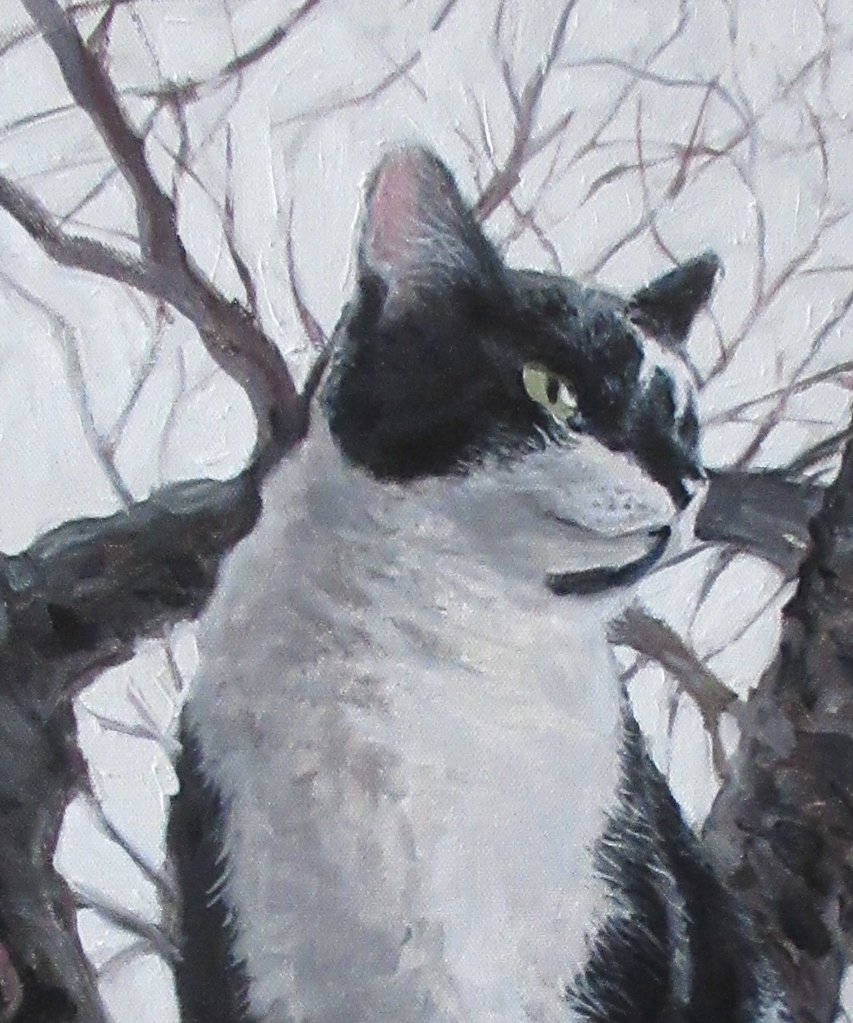
Robert Bateman, the great wildlife artist, taught us a lesson about white snow. He said he’d painted a snow scene with deer footprints but somehow it didn’t look right. So he want outside and looked. Sure enough, the dark foot prints were wrong! What he realized was that the flat surface of the snow was reflecting the blue sky, turning it a rather light/medium grayish blue value. But the deer tracks were a bright, warm white. Why was that? In winter, the sun is at a lower angle and its rays were hitting the deer footprints at a 90 degree angle, head-on. So when I went to paint the white of my cat, I visited the orchard to compare the white snow on the branches to the white of the sky. Surprise, surprise! The sky was “whiter” than the snow.

I’d thought I’d be able to finish this painting today, but no. The “black” fur on Picasso was still too wet to work over. Still too wet to paint in whiskers! So I worked on the trees and added a couple birds. I painted in a windowsill for Picasso to sit on, but decided this painting was too blah, too predictable. What would make it interesting? I began painting in a piece of fabric for him to sit on. I was too impatient to wipe the windowsill paint off. I started slapping on some of the wild design of the fabric – just for the heck of it. I think it’ll turn out good when I’m finished.
Another bit of wisdom Robert Bateman told us: try to make your paintings look like something nobody’s seen before. If you’re painting a deer, don’t make it standing sideways in a field, looking in a profile. Make it do something different. In other words, throw in something a little unexpected.
Here’s Day 3:

 Margie Guyot Art